By: Julie Midura
𝐒𝐨 𝐘𝐨𝐮 𝐖𝐚𝐧𝐭 𝐭𝐨 𝐇𝐢𝐤𝐞 𝐢𝐧 𝐖𝐢𝐧𝐭𝐞𝐫?
“This is stupid! I have no intention of dying up here just to bag another peak!” my husband Tom yelled in an attempt to be heard over the cacophony of howling wind and blowing snow.
We were three tenths of a mile from the summit of 4,170 foot Mt. Cabot in the White Mountains of New Hampshire when nature unleashed 40 mile per hour winds and wind chills in the negative thirties. We waded through snowdrifts that were up to our thighs in an attempt to find any sign of a trail. All was lost in the endless sea of white.
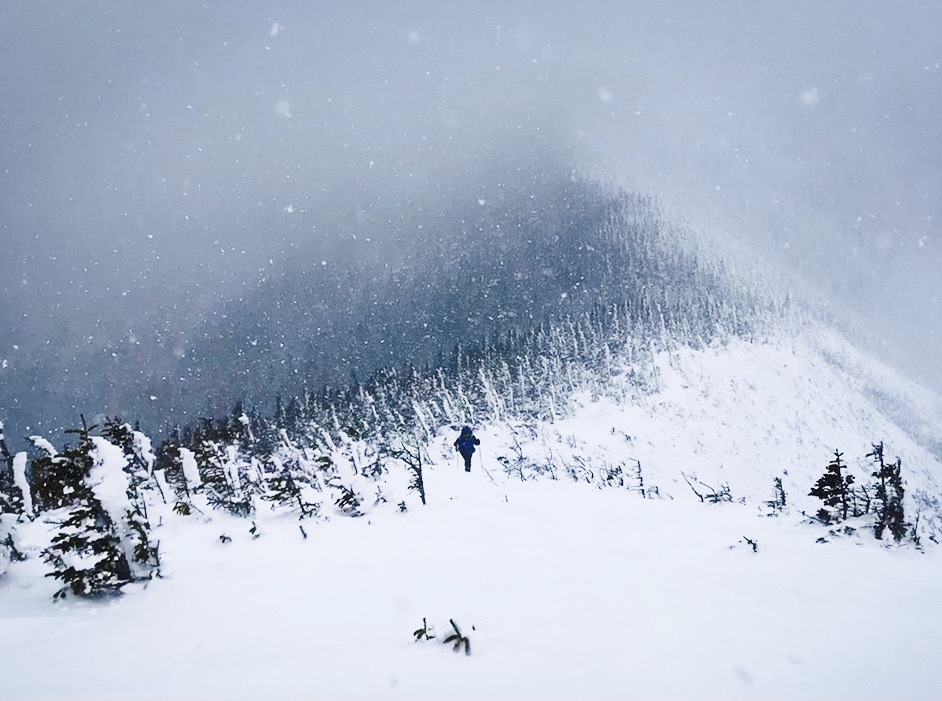
Tom and I were in the process of attempting to become members of the AMC 4,000 Footer Club by climbing all 48 four thousand foot mountains in the White Mountains. Although we had already climbed 35 of the 48 peaks, we had only completed 8 of them in winter. Thankfully, self-preservation kicked in on our attempt to reach the summit, and we turned around just three tenths of a mile from the summit. On that day, we learned that in addition to the proper gear, the single most important thing to remember when climbing mountains in winter is to trust your instincts. The lessons we’ve learned since that day have kept us from becoming another statistic in a mountain region whose winter conditions rival those found on Mt. Everest.
Now that we have completed 45 of the 4,000 footers in winter, I’d like to share some winter hiking tips that we’ve picked up along the way, in the hopes that the mistakes that we’ve made will prevent YOU from making the same ones. I’ll cover Safety Gear, Layering, Traction, Hydration and Nutrition. And regardless of the season, you should remember to be prepared, to know your limits, to be willing to turn back, and to check the weather forecast.
In the past five winters of hiking 4,000 footers, Tom and I have come to realize that the mountains have no concern for our welfare. If we choose to enter her forbidden world, we need to know when to surrender. So we bow to her fluctuating moods. We concede in the face of insurmountable obstacles. We remember that in a battle of wills, the mountain will always win.
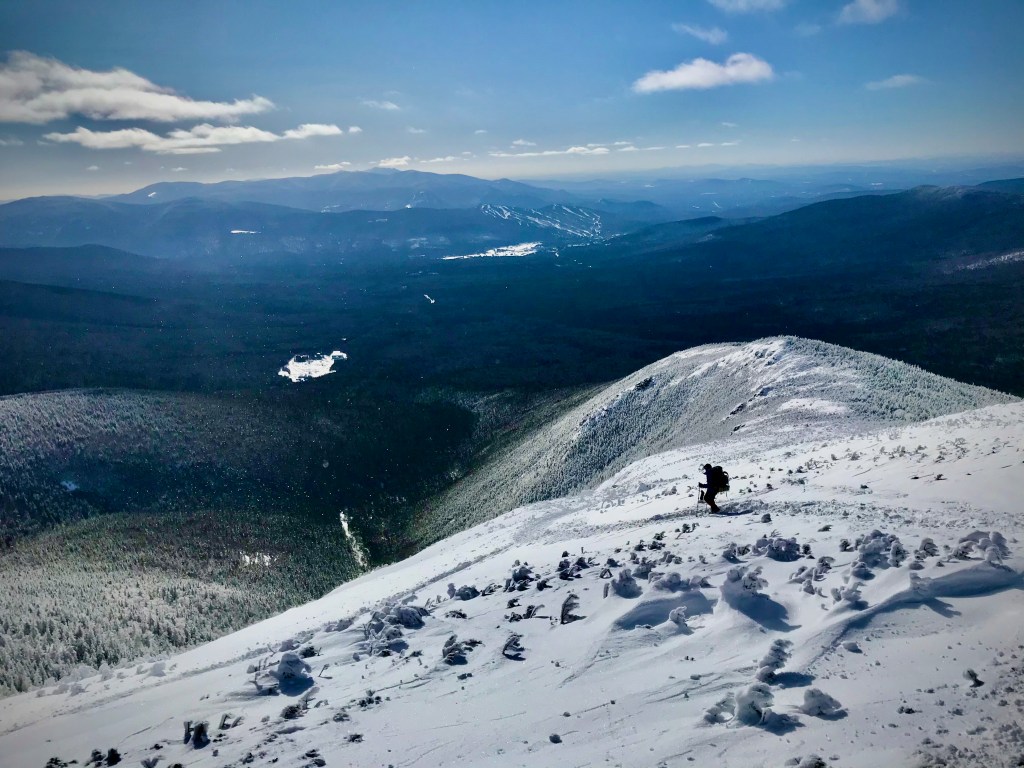
𝐒𝐀𝐅𝐄𝐓𝐘 𝐆𝐄𝐀𝐑:
“Are you guys spending the night out here?” yet another hiker asks as we pass each other on the trail. We’re not, but our 50 liter winter backpacks would suggest otherwise.
When hiking in winter, the items you carry in your backpack can mean the difference between life and death. The fact is, accidents happen and weather comes in fast and furious in the mountains, and you should be prepared with enough gear to survive an unexpected night in the woods in subzero temperatures.
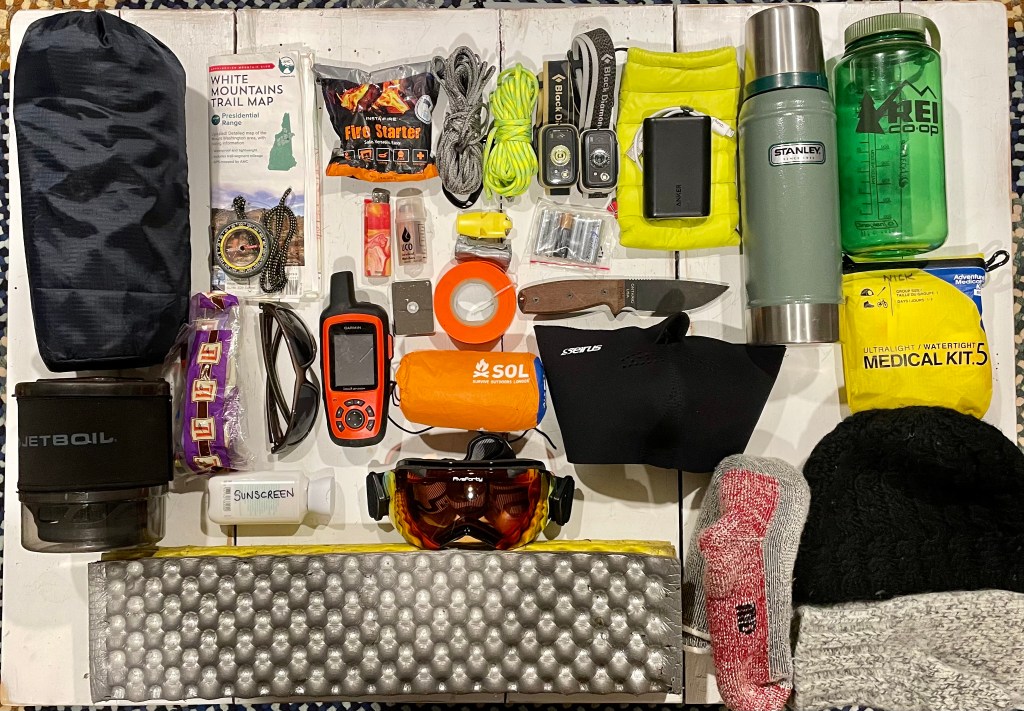
Tom and I carry the following Ten Essentials in our backpacks in every season: Map & compass; sun glasses and sunscreen; extra clothing; headlamp & extra batteries; first aid kit; matches, lighter, fire starters; duct tape, multi tool, rope, whistle; extra food; extra water; shelter (bivy sack.)
In winter, we add:
➺ Therm-a-rest Foam sleep pad to stay off the wet snow.
➺ Fleece sleeping bag liner or sleeping bag
➺ EXTRA hat, mittens, socks
➺ Bread bags for feet in case of water crossing. Pull them over socks, then place boots back on to keep socks dry.
➺ Roll of red non-adhesive flagging tape. (If disoriented in sudden white-out, can be used to navigate from one cairn to the next or tied to trees as a location marker. It weighs less than paracord and allows you to carry hundreds of feet on a small roll.)
➺ Phone charger- keep in insulated case with an activated hand warmer.
➺ Emergency locator beacon. (SPOT, Garmin, etc)
➺ Emergency tarp
➺ Camp Stove- To melt snow
➺ Stylus for operating phone camera so you don’t have to remove gloves or mittens
𝐋𝐀𝐘𝐄𝐑𝐈𝐍𝐆 𝐒𝐘𝐒𝐓𝐄𝐌
”Be bold, start cold” and “Cotton kills”
are the mottos to live by when dressing for winter hiking. I used to step out of my car at the trailhead wearing enough layers for a day on Everest, but within minutes, I was sweating profusely from the exertion. Once your clothing is wet from perspiration, you’re at risk of hypothermia, so the key is to regulate your body temperature by adding and removing layers as your exertion level fluctuates.
The actual layers that you wear are as important as knowing when to add and shed them. I carry a minimum of four layers for my upper body and three layers for my lower body on every winter hike. How hot or cold you hike will determine how many layers you need, but the basic premise remains the same.
Upper Body
➺ Your base layer should be merino wool, poly, or silk. Basically, anything that pulls moisture away from your skin. I use a quarter zip merino top that I can unzip to avoid overheating. Some hikers remove their damp base layer and slip into a dry base layer before they break above tree line.
➺ Second layer is a full zip insulating layer- often fleece. I also carry a synthetic vest in order to keep my core warm.
➺ Third layer is usually a hooded puffy. Options are synthetic or down. There are pros and cons of both. I love the insulation value for the weight of down, but it becomes useless once it’s wet. Synthetic will insulate even when wet. I often only add this layer on the summit or if I need to stop for more than a couple of minutes.
➺ Top layer should be a wind/waterproof hooded shell. Pit zips are a must in order to dump heat. And remember that you may have to go up a size, since you’ll be wearing it over several other layers.
➺ Merino wool bra. Non-cotton underwear.
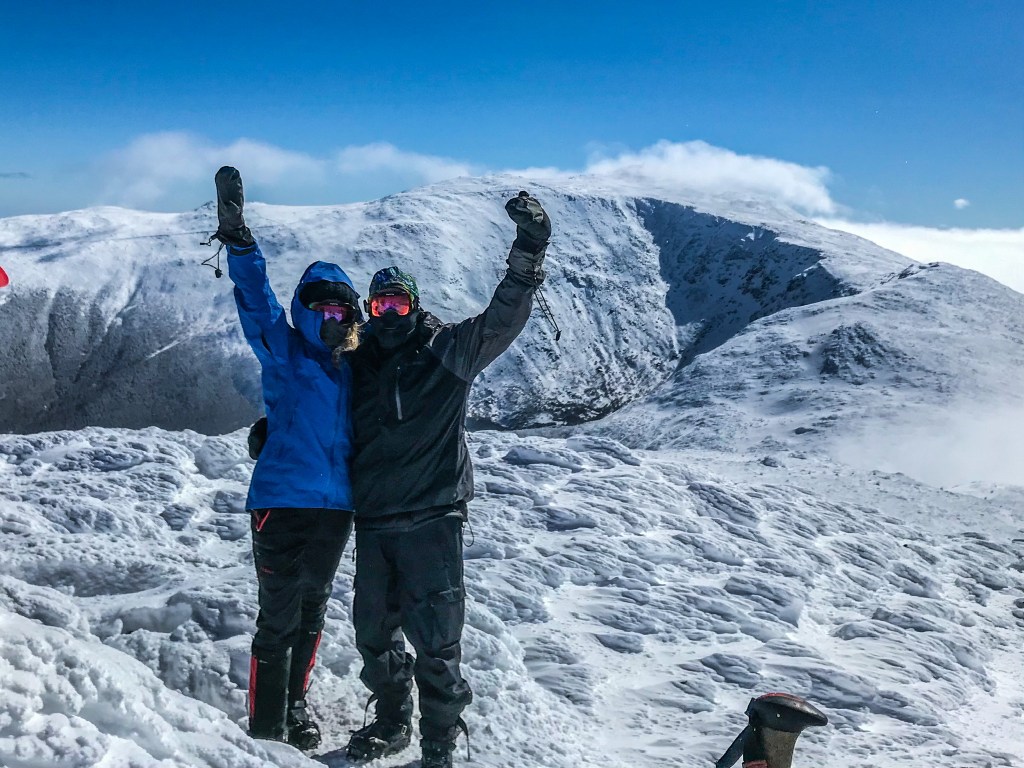
I also bring 2 hats, a balaclava, a neoprene face mask and ski goggles.
Lower Body
Most hikers can manage with less layers on their legs than their upper bodies. Options include fleece leggings, fleece lined hiking pants, a thermal hiking skirt, and waterproof side-zip shell pants. I always wear knee-high gaiters on my legs, both for the added insulation, and to avoid ripping holes in my pants from my spikes. And remember that “Cotton kills.” Cotton fibers trap moisture, causing rapid loss of body heat, which can lead to hypothermia.
For toasty feet, I wear wool mountaineering knee socks and 400 gram winter boots. If it’s an exceptionally long hike in below zero temperatures, I add full-sole foot warmers rather than just toe warmers. And if you plan to wear sock liners under your socks, be sure that your boots are sized to accommodate the multiple layers. Boots that are too tight will restrict blood flow and your feet will be colder, not warmer.
Mittens/Gloves
“How much are your hands worth to you?!”
Tom and I were heading to the summit of our first winter 4,000 footer when his legs were wracked with excruciating spasms. During the 15 minutes before he was able to walk again, my hands were getting colder and colder in the sub-zero temperatures. I tried circling my arms like a windmill to bring the blood circulation back into my hands, but nothing worked. My hands felt like icicles.
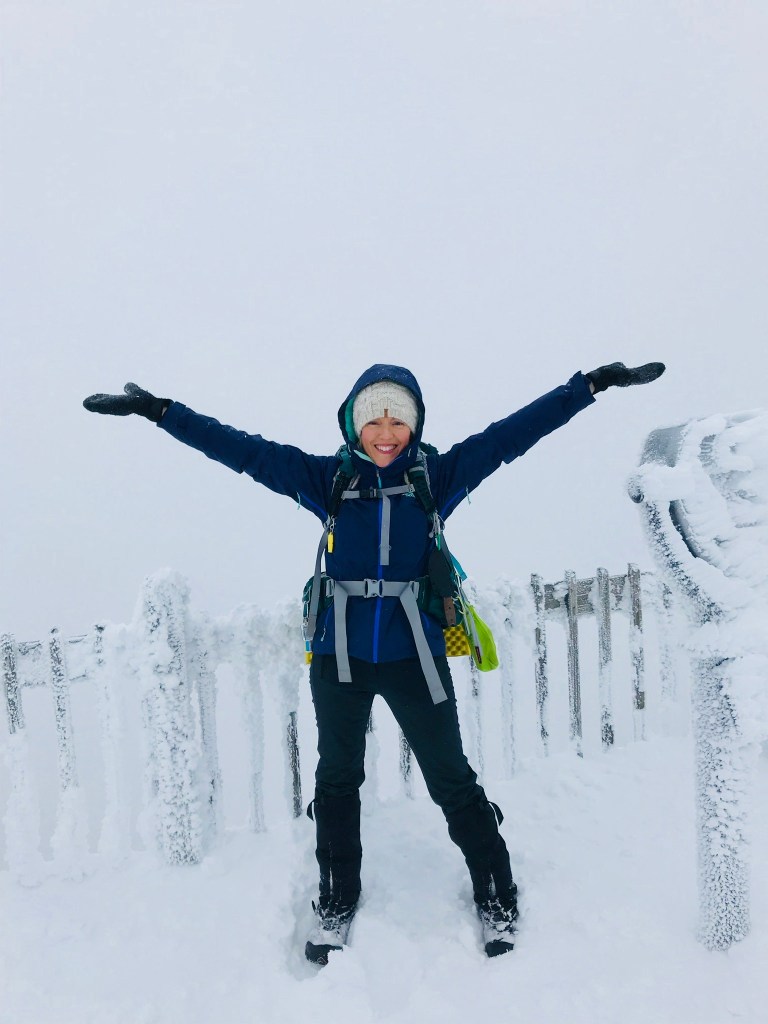
Thus began my two year quest to find bomb-proof mittens or gloves that would actually keep my hands warm on the brutally cold 6-8 hour days in the mountains. Through trial and error, and at least a dozen glove/mittens later, here’s what I learned….
➺ Mittens are much warmer than gloves.
➺ You need a more lightweight pair of gloves or mittens for the ascent than you do for the summit since you generate an enormous amount of heat while climbing.
➺ Ascent gloves/mittens will likely get wet from perspiration, so bring a spare pair.
➺ Gloves or mittens that are too tight will restrict blood flow and will not insulate as well. Air is one of nature’s best insulators. Size up when in doubt.
➺ Always carry a few hand warmers for emergencies or if you decide to spend time on the summit in sub-zero temps. Activate them well before you plan to use them.
➺ If you plan to take lots of pics, wear thin liner gloves under your mittens to avoid bare skin exposure. Or use a stylus to take pics with your phone.
➺ If you take off your gloves/mittens for any reason, don’t place them on the ground or even on your trekking poles. Instead, stuff them in your jacket to keep them warm.
I now have a three layer bombproof mitten system that keep my hands warm even when we spend extended time in the alpine zone.
➺ Base layer: Dachstein Austrian boiled wool mittens.
➺ Mid and top layer: Outdoor Research Alti Mitts. These are a two layer system. They have an insulating fleece mitten as well as a thick Gore-TEX water repellent shell with leather palms. They are made for Arctic expeditions… and are priced accordingly. Remember to go up a size on these if you plan to wear the Dachstein’s underneath.
Traction
We were new to winter hiking and heading to the summit of a 4,000 footer when the 3” of snow at the trailhead became a foot the higher up we climbed. Little did we know that day as we hiked up the mountain leaving bomb craters in our wake that we were engaging in a controversial act.
𝐏𝐨𝐬𝐭-𝐡𝐨𝐥𝐢𝐧𝐠 occurs when a hiker who isn’t wearing snowshoes plunges anywhere from calf to thigh deep into the fresh snow, creating deep holes in the trail. These holes can be annoying at best, and potentially hazardous at worst, since other hikers must maneuver around them and potentially suffer a leg injury if they fall into one. The best way to avoid post-holing is to wear snowshoes after a fresh snowfall in order to pack out the trail.
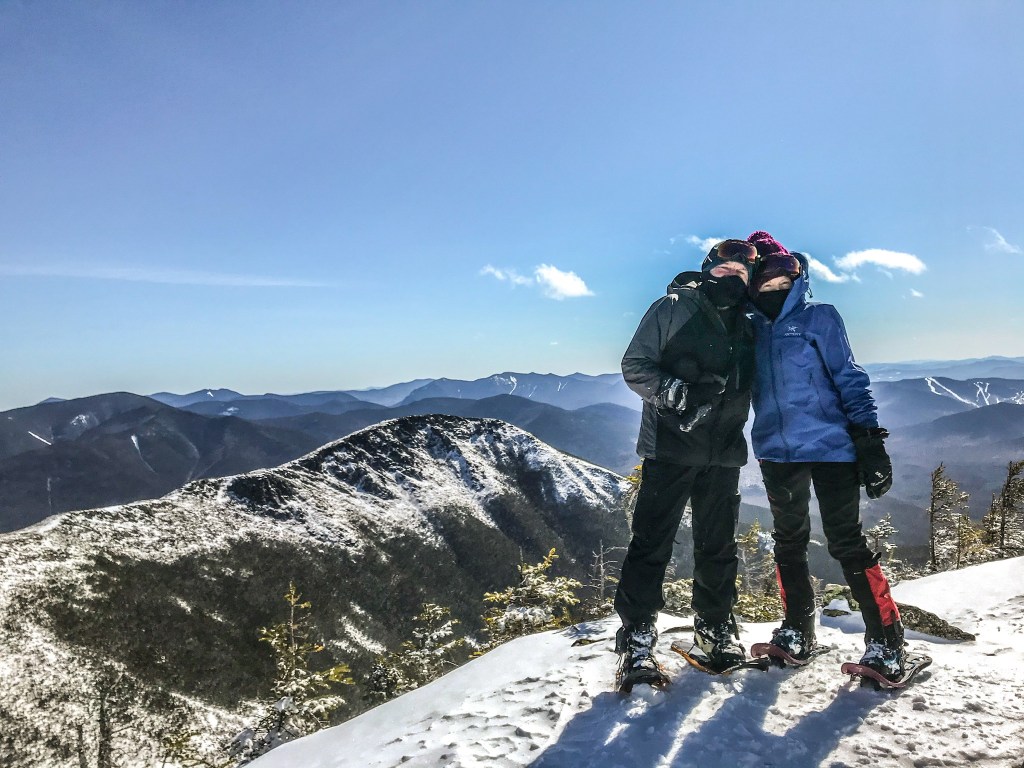
Snowshoes
The features we look for in snowshoes are:
➺ Lightweight
➺ Televators- a wire bale that flips up under your boot, lifting your heel and reducing calf fatigue.
➺ Aggressive crampon
➺ A binding system that is easy to put on and adjust even with mittens on.
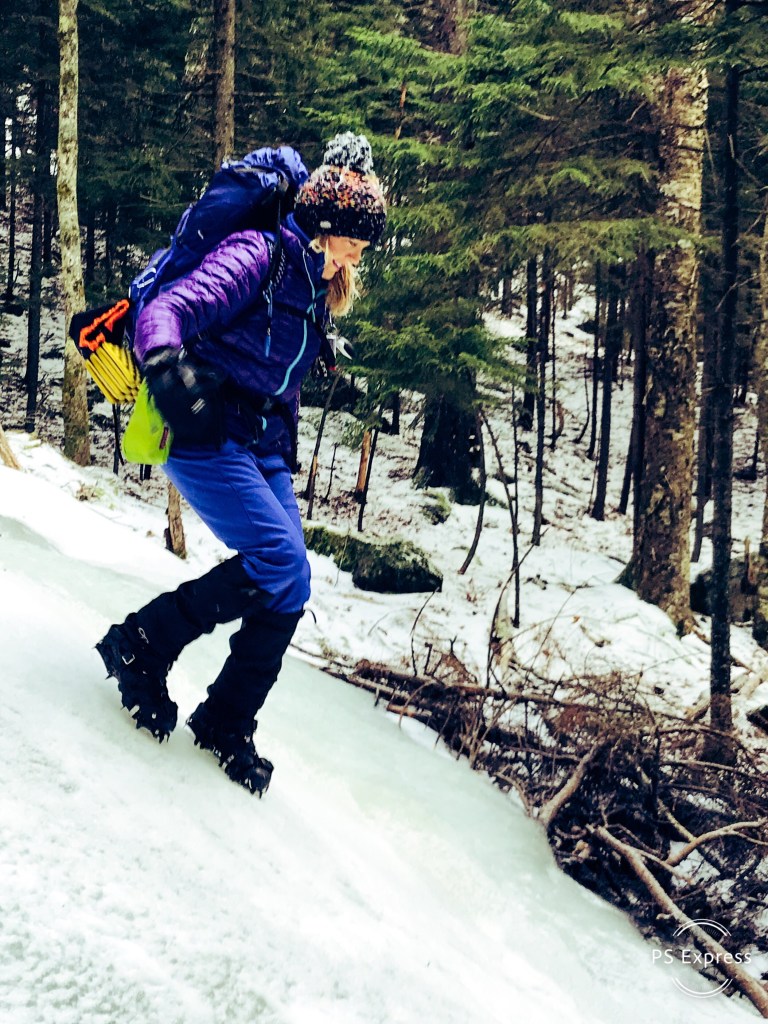
Spikes/Crampons
When the trails are well packed out and there is no risk of post-holing, we wear spikes instead of snowshoes. We use various levels of traction based on the trails conditions. The brands that we use include:
➺ 𝐊𝐚𝐡𝐭𝐨𝐨𝐥𝐚 𝐌𝐢𝐜𝐫𝐨𝐬𝐩𝐢𝐤𝐞𝐬: Feature twelve 𝟑/𝟖 𝐢𝐧𝐜𝐡 𝐥𝐨𝐧𝐠 stainless steel spikes.
➺ 𝐇𝐢𝐥𝐥𝐬𝐨𝐮𝐧𝐝 𝐓𝐫𝐚𝐢𝐥 𝐂𝐫𝐚𝐦𝐩𝐨𝐧𝐬: Feature eleven carbon steel 𝟐/𝟑 𝐢𝐧𝐜𝐡 𝐥𝐨𝐧𝐠 spikes.
➺ 𝐊𝐚𝐡𝐭𝐨𝐨𝐥𝐚 𝐊-𝟏𝟎 𝐂𝐫𝐚𝐦𝐩𝐨𝐧𝐬: Feature ten 𝟑/𝟒 𝐢𝐧𝐜𝐡 𝐥𝐨𝐧𝐠 spikes.
We tend to wear our Hillsounds most often because they are ‘middle of the road’ spikes that serve well in most of the conditions that we encounter.
We reserve our K-10’s for icy conditions, steep ascents, and/or the times when we will be spending a significant amount of time in the alpine zone. These crampons should be fitted to your boot prior to your hike to insure a good fit. Once fitted, they are easy to get on and off, with 2 simple buckle closures. And remember to carry zip ties and/or small key rings to do field repairs if your traction breaks.
Hydration
It was a frigid winter day on the ridge between Mt Pierce and Mt Eisenhower. I pulled the tube of my hydration pack out of my jacket, bit down gently on the bite valve… and got no water. Even though I had blown the water back into the reservoir the last time I took a sip and had tucked the tube close to my body under my jacket, it was still frozen solid. Tom hikes hotter than I do, so his valve was fine. He shared. What a guy!
I now use Nalgene bottles in winter instead of a bladder:
➺ Fill 2 Nalgene bottles with hot water.
Place them in thick wool socks to insulate. (There are insulated sleeves that do the same thing, but my dad’s old hunting socks do the trick just fine.)
➺ Place one of the bottles in the center of your backpack for later, and one in the side mesh pocket for easy access.
➺ Place both bottles UPSIDE DOWN. (Water freezes from the top down, so if it does happen to freeze, when you turn it upright, the frozen part will be on the bottom of the bottle and you’ll still be able to drink from the top.)
➺ Place a silicone straw in the bottle if you’re clumsy so that you don’t spill water all over yourself when you tip the bottle to your mouth. (I blame it on my big mittens. You lose all dexterity while wearing those things!
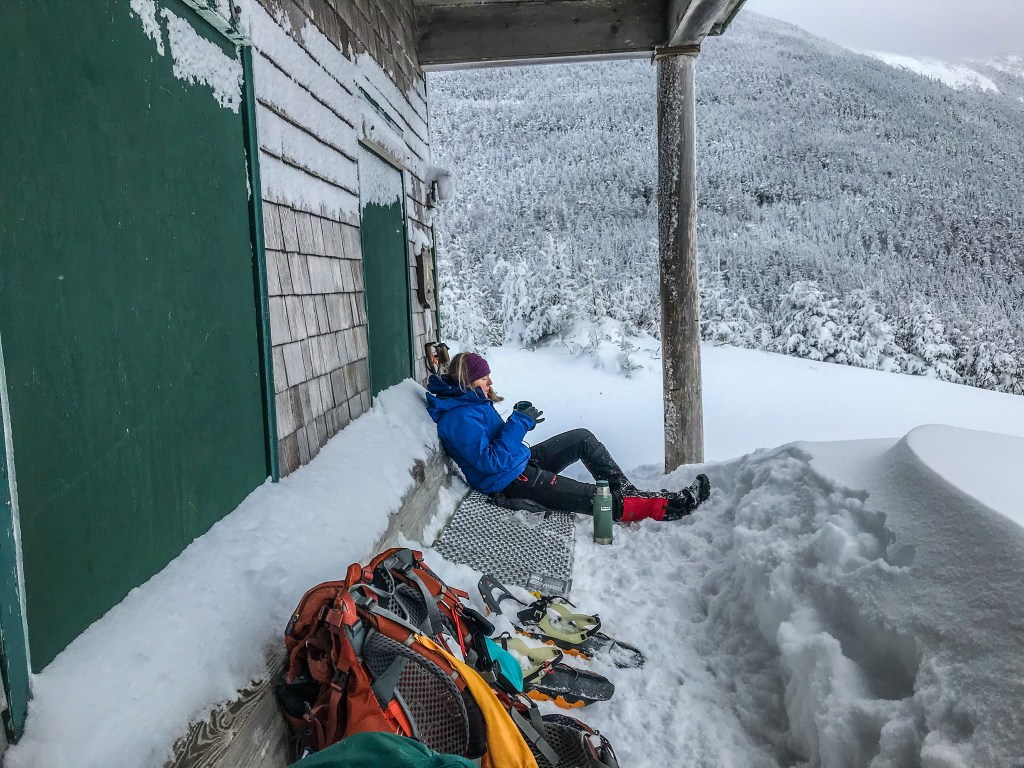
We also bring a thermos of hot cider or hot cocoa for the summit. (Some add a bullion cube to hot water.) There’s nothing like sipping a steaming mug of hot 𝐚𝐧𝐲𝐭𝐡𝐢𝐧𝐠 to take the chill out of your body and restore your stamina for the long hike down! And remember to drink frequently throughout your hike. We tend to drink less in winter because we don’t feel as thirsty in the cold temps, so it’s easy to get dehydrated in winter.
Dehydration increases your risk of hypothermia.
Bonus tip: Add a packet of jello to your first aid kit. Jello diluted in hot water provide lots of sugar and calories to crank up the metabolism of someone suffering from hypothermia.
A word on alcohol- although it does give you a nice warm glow and a moment of heat deep in your gut as if goes down, alcohol will cause your body temperature to drop. Just sayin!
Nutrition
Think calories, nutrient dense, and things that won’t freeze and crack your tooth requiring an implant at the cost of 4 grand. Right Tom?
Our usual snacks include:
➺ Sandwiches like nut butter & jam
➺ Ritz crackers
➺ Salami/ pepperoni/ beef jerky
➺ Chocolate
➺ Dried fruit
➺ Nuts
➺ Hot soup in a thermos
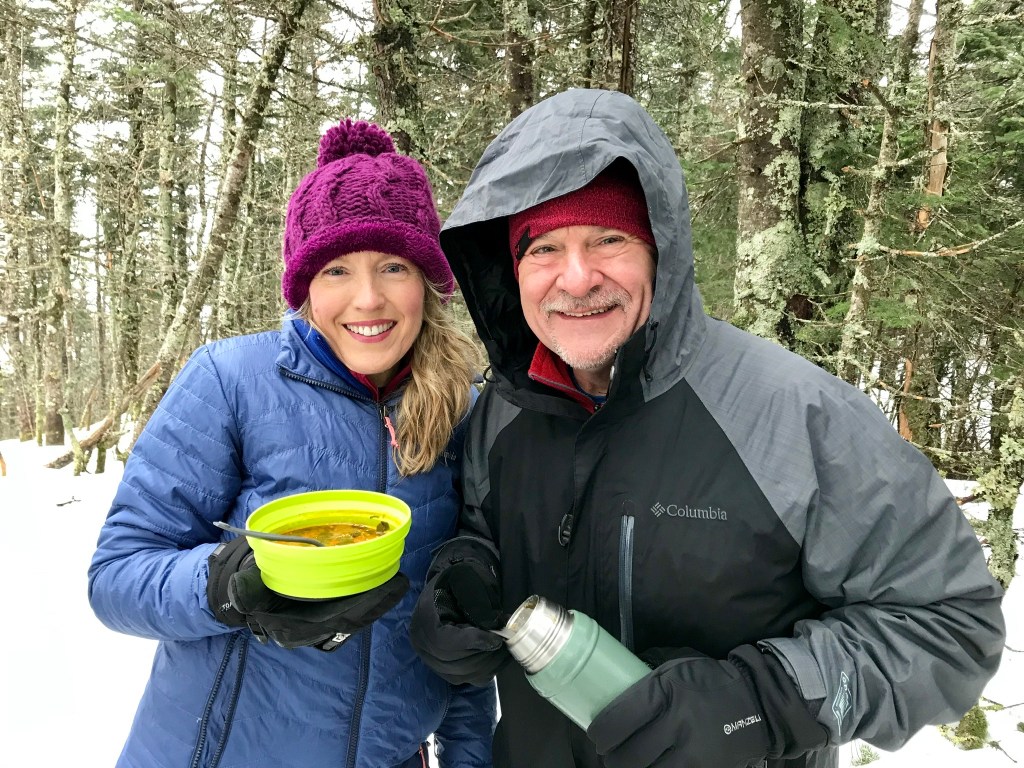
Mt. Tecumseh
Energy bars tend to freeze solid, so if you do bring those, remove the wrappers at home, cut them into strips or bite size squares, and place in a ziplock bag so that you don’t have to fumble with unwrapping them while wearing mittens or gloves. Place them in an inner pocket close to your body, or in an insulated bag with a couple of activated hand warmers to keep them from freezing.
A Few Final tips
➺ Leave your itinerary with one or two people. They should know your start time; where your car will be parked; your planned route and when you expect to be back. If possible, send them texts as the hike progresses so that if something goes wrong, they are aware of your last known location.
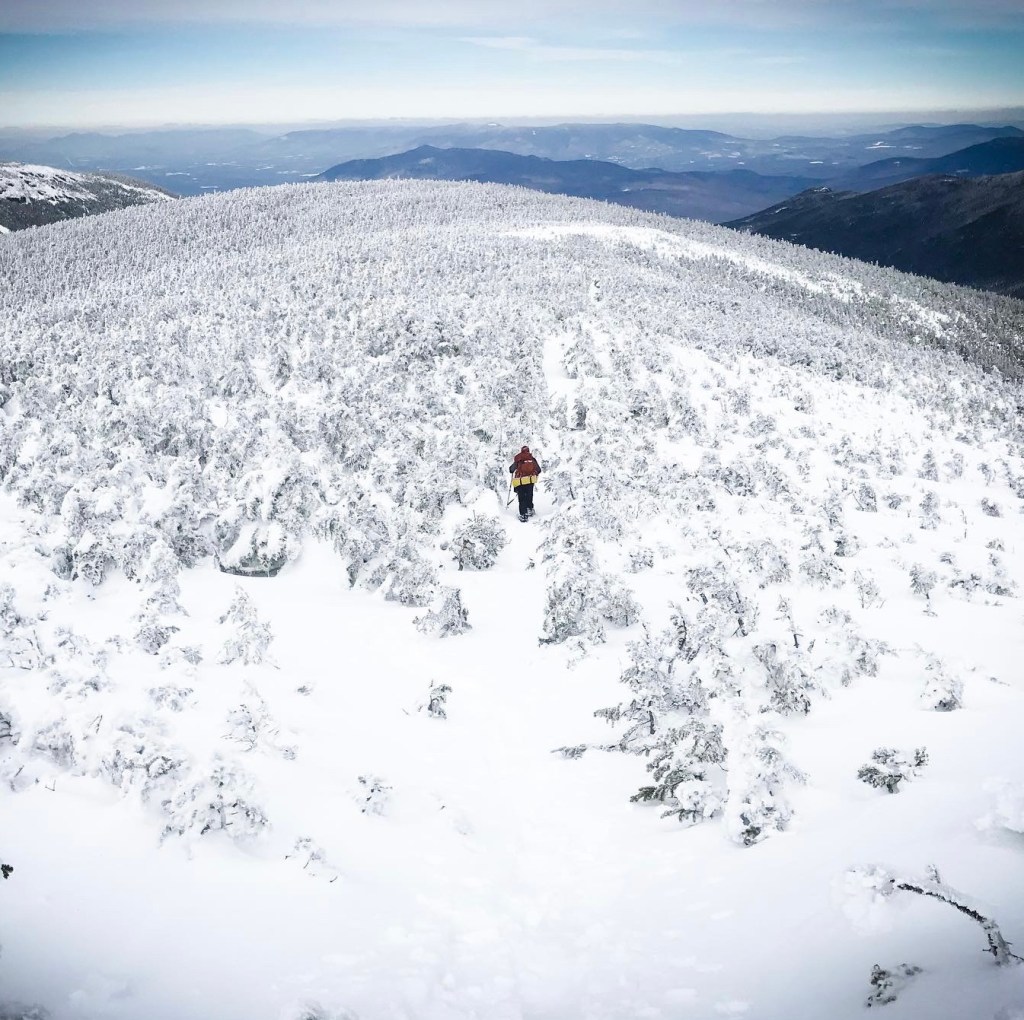
➺ Keep a snow shovel in your car to dig your car out in the event it snows while you’re on the mountain. OR if a snowplow happens to go by and piles up snow in front of your car.
➺ Be aware of the symptoms of hypothermia, which occurs when your core body temperature decreases significantly enough to impair muscular and cerebral functions. It can affect your ability to think clearly. Hypothermia can be caused by cold temperatures, inadequate clothing, becoming wet from snow, rain or perspiration, fatigue or exhaustion, dehydration, inadequate food intake, and alcohol. Signs of hypothermia include uncontrollable shivering, garbled speech, inability to communicate, fumbling or lethargy. Look for the UMBLES- when someone begins to jumble words, fumble with gear, stumbles or tumbles, it could be an early sing of hypothermia. Simple ways to test for hypothermia Include touching thumb to each individual fingertip starting with pinkie, then reversing, or asking a basic math problem.
If you suspect hypothermia, be gentle; insulate the person from the cold ground; remove wet clothing and get them into dry ones; wrap them with coats or sleeping bags, and apply hand, foot or body warmers to neck, chest and groin only. If the person is alert and able to swallow, offer a warm sweet beverage.
➺ Always test your gear on a smaller hike before you head up a 4,000 footer. I’d rather discover that my boots don’t keep my feet warm enough when I’m 30 minutes from my car, rather than when I’m in the alpine zone 5 miles from the trailhead.
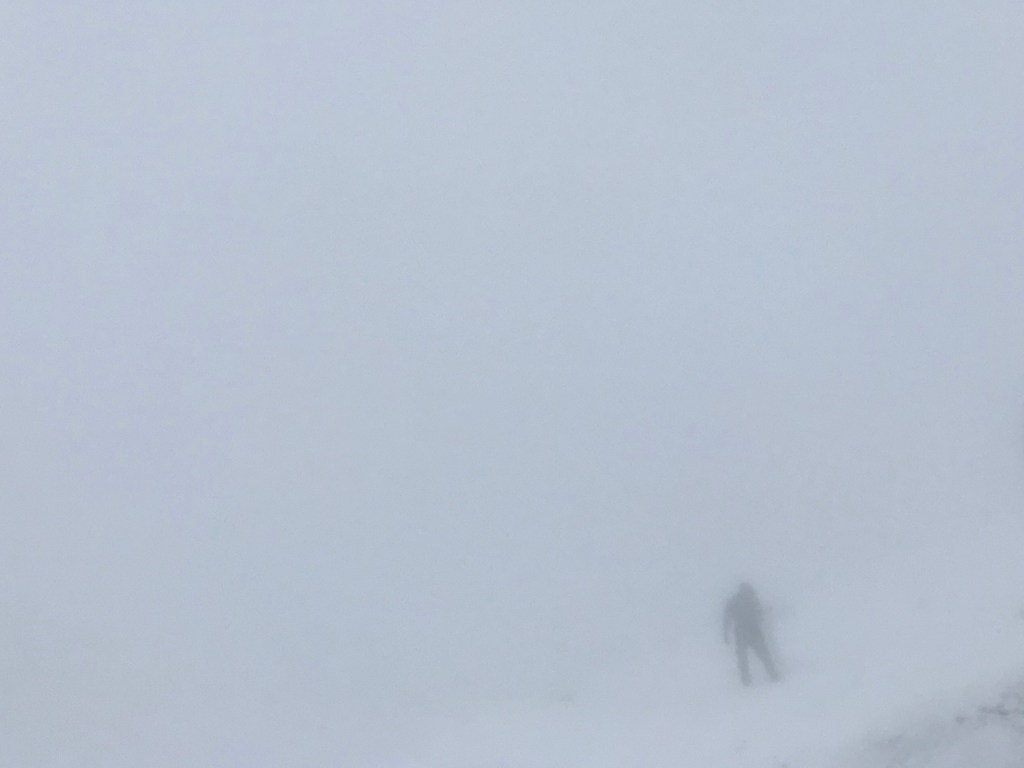
𝐃𝐨𝐧’𝐭 𝐭𝐫𝐲 𝐭𝐨 𝐨𝐮𝐭𝐫𝐮𝐧 𝐭𝐡𝐞 𝐬𝐭𝐨𝐫𝐦.
Many of us have been there. We’re approaching a summit on a frigid winter day. We’ve driven several hours from our homes just to reach the trailhead.The forecast says a storm is coming in… but we’re certain that we can beat it.
We know that we can make it to the summit and be at least partway back down before the conditions deteriorate. 𝐁𝐞𝐟𝐨𝐫𝐞 the clouds darken and the skies rage. Before white ground and white sky suddenly become one, and it becomes impossible to tell the difference between the two. Before the bitter cold invades our bodies and overtakes our minds. Before the savage and unrelenting wind slams into us, and churns the snow into piercing crystals that assault every inch of our exposed skin. Before nature unleashes her madness, and we are caught in the middle of it.
We can make it.
𝐂𝐚𝐧’𝐭 𝐰𝐞?
If you choose to hike in winter, remember that the most important thing 𝐢𝐬𝐧’𝐭 reaching the summit. The most important thing is making it back to the car at the end of the day.
My husband Tom and I became avid hikers and backpackers in 2016 when we learned about a list of forty-eight 4,000 foot mountains in the most rugged landscape of New Hampshire. If we climbed them all, we would become members of the Appalachian Mountain Club 4,000 Footer Club. At the ages of 51 and 59, it seemed like an improbable goal that would take a lifetime to achieve. Instead, it became an exhilarating quest that would change the trajectory of our lives. During the pursuit of our goal, a simple fall while coming off of our 35th mountain became the catalyst for a series of events that threatened to end our peak bagging quest, while the medical emergency that followed taught us how fleeting life can be.
Once we went on to complete all 48 four thousand footers, I decided to write a book about our journey. It will be released later this year.
Our inspirational story will take you from the deepest valley to the tops of New England’s grandest mountain peaks. It will give you a first hand look into the life of a couple who decided that middle age doesn’t have to mean a long, slow, boring ride to the grave. It’s a story that is not only about mountains, but also about love, about life, about defeat, about victory, about strength and about passion. It’s a story that will prove that it’s never too late to redefine your ordinary life in order to pursue an extraordinary one!
It’s a story that is about “More Than the Mountain!”
I hope that you will follow along with us as we continue our hiking and backpacking adventures in the mountains and valleys of New England! We’ve got something big planned, and you’re not going to want to miss it!
Follow us on Instagram @morethanthemountain
See you in the mountains!
Julie Midura~ aka ‘Glory’,
along with my mountain man Tom~ aka ‘Granite’
 from the other side
Julie and Tom, this was SO informative! I appreciate that you listed reasons for carrying each piece of gear and how to strategize for staying warm and dry. I’ve been ratcheting up the difficulty of my winter hikes this year and you’re so right that a trial hike close to home is a great way to test out a gear kit. Thanks for this awesome reference!
Reblogged this on Whipped Owl and commented:
Useful advice for winter hikers/outdoors enthusiasts.